
TL;DR
- AI only becomes reliable when it operates inside trusted feedback loops.
- In commerce, the most important feedback loop is real-time sales data at the point of transaction.
- That loop is structurally broken today, creating delay, dispute, and inefficiency - the trust tax.
- Real-time, permissioned data sharing between retailers and brands is now possible via POS systems.
- When the loop closes, a System of Trust forms: execution improves, incentives align, collaboration replaces negotiation.
- This creates a new operating model - Intelligent Commerce - where advantage compounds through better feedback, not data aggregation.
- Once embedded, operating without this model becomes economically irrational.
Author's point of view
This document is built on a simple belief: systems only become intelligent when they can trust and rely confidently on their own feedback.
- AI only works effectively when it operates inside trusted feedback loops. Without verified outcomes, AI optimises abstractions, not reality.
- In commerce, the most important feedback loop is sales data at the point of transaction. What sold, where, when, at what price, and under what conditions.
- That loop is structurally broken today. Truth is delayed, aggregated, intermediated, and disputed.
- This gave rise to the data aggregation era. A necessary workaround - useful, but slow, indirect, and incompatible with real-time execution or AI.
- That constraint no longer exists. Real-time, permissioned, shelf-level data sharing is now possible via point-of-sale systems.
- When the loop closes, a System of Trust forms. Decisions move from opinion to evidence. Reporting becomes learning. Negotiation gives way to collaboration.
- This creates a new operating model: Intelligent Commerce. Trust is operationalised, incentives align, execution improves, and value compounds structurally.
- Competitive advantage no longer comes from owning data. It comes from increasing the velocity, fidelity, and economic alignment of feedback across the network.
System sketch
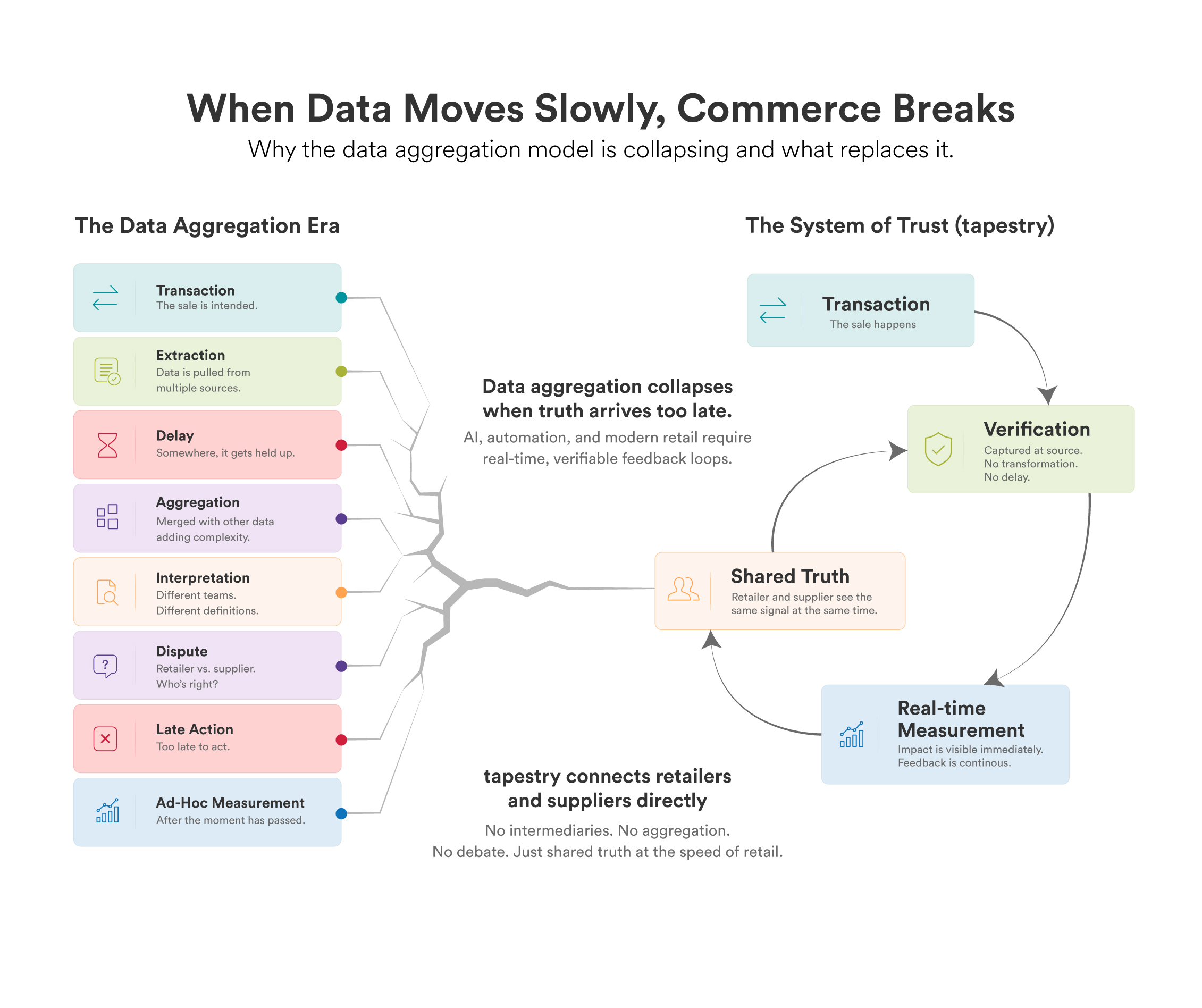
Everything that follows expands, evidences, and operationalises this shift in feedback velocity and fidelity.
Executive summary
Artificial intelligence only becomes valuable when it operates inside trusted feedback loops.
In commerce, the most important feedback loop is sales data - what shoppers actually buy, where demand appears, and how value moves through the supply chain and the economy.
For decades, this loop between retailers and brands has been indirect. Sales data was delayed, aggregated, and filtered through third parties. This gave rise to the data aggregation industry - a necessary workaround that was useful, but slow, indirect, and distorting. Decisions were made after the fact. Execution lagged reality, creating lost opportunities in both sales and profit for store owners.
That constraint no longer exists.
Today, real-time, shelf-level sales data can be shared directly between retailers and brands at the point of transaction. When this loop closes, a System of Trust forms inside commerce itself. Decisions shift from speculation to evidence. Reporting becomes learning. Negotiation gives way to collaboration.
This change does more than improve analytics - it changes how work gets done.
Retailers, brands, wholesalers, and POS providers begin operating from the same live signal, coordinating execution around shared, verifiable outcomes. New workflows emerge: joint store-level planning, faster promotion testing, coordinated replenishment, and real-time responses to local demand. Incentives align because value is measured against the same underlying sales data that governs participation and pricing.
As AI becomes mainstream, operating outside trusted feedback loops is no longer viable. AI does not learn from abstractions or delayed reports. It learns from verified outcomes. When embedded inside real-time commercial feedback loops, AI moves from analysis to orchestration - measuring actions, learning continuously, and improving execution as it happens.
This thesis describes the emergence of Intelligent Commerce: a new operating model in which trusted feedback loops align people, capital, and AI around execution rather than negotiation.
Competitive advantage no longer comes from owning data. It comes from increasing the velocity, fidelity, and economic alignment of feedback across the network.
Once trusted feedback loops are embedded at the point of transaction, advantage compounds structurally: learning accelerates, switching costs rise, and alternative operating models become economically inferior.
Intelligent Commerce is not an incremental improvement in reporting. It is the System of Trust in action, applied to the economy - and it is already compounding.
Frame I - The problem: commerce has a confidence gap
Why commerce suffers from a confidence problem
In September 2025, we released our thesis: The System of Trust - what comes after action.
It presented a philosophical frame for understanding the next era of artificial intelligence - not as a set of features, but as a new relationship between people, machines, and the systems we rely on to coordinate reality.

This thesis applies that same frame to commerce.
If a System of Trust is the what, then this is the so what - specifically for commerce, where millions of daily decisions depend on the most fragile ingredient in the system: confidence.
Retail has become extraordinarily good at moving physical goods. But it remains surprisingly poor at moving truth.
Commerce does not run on inventory alone. It runs on shared understanding:
- what sold
- where
- to whom
- at what price
- under what conditions
- and what should happen next
When that understanding is late, disputed, incomplete, or intermediated, the system pays a tax - in the form of buffers, hedging behaviour, cost, confusion, and mistrust.
A System of Trust introduces the missing element: a verified feedback loop that makes commercial intelligence reliable enough to act on in real time. This is what we call Intelligent Commerce.
The missing feedback loop
Retail runs on two supply chains:
- The physical supply chain that moves products.
- The information supply chain that moves truth.
The first has been refined for decades. The second remains largely broken.
Truth in retail often arrives late, incomplete, indirect, or via intermediaries far from the underlying event.
When feedback is missing, the system compensates:
- Retailers carry buffer stock.
- Suppliers oversell.
- Wholesalers overstock.
- Disputes increase.
- Costs are inflated.
These behaviours are not failures of character. They are structural compensations for missing trust. They are what we call the trust tax.
Use case - store-level beverage execution
A global beverage supplier does not know what actually sold in Store #147 until weeks later. The fridge layout is optimised for an average store, not this store. Capital is deployed based on historical interpretation rather than live evidence.
This is not a tooling problem. It is a feedback problem.
Bridging trust to economic impact
A System of Trust only matters if it changes how work gets done - and how value is created.
In Intelligent Commerce, closing the feedback loop at the point of transaction does not merely improve visibility; it alters execution itself. Store-level decisions become evidence-driven, capital allocation tightens, empowering those at store level.
What begins as verified truth at the shelf propagates upstream into replenishment, pricing, promotion, and planning - compressing learning cycles and reducing the cost of error.
The economic impact of trust is therefore not abstract. It appears as higher revenue per square metre, improved working-capital efficiency, faster execution cycles, and structurally higher return on invested capital across the network.
Trust becomes operational. Outcomes become measurable. Confidence compounds - not as belief, but as economics.
Intelligence as a tool, not a trait
We define intelligence in commerce not as an attribute, but as a tool for decision-making across three layers:
- Personal Intelligence - insights that improve outcomes for individuals.
- Social Intelligence - coordination, norms, agreements, and trust.
- Commerce Intelligence - decision-making across markets, companies, and supply networks.
A System of Trust is fundamentally a social-intelligence mechanism. It facilitates how parties relate, verify, and coordinate. Its most powerful and immediate impact, however, emerges in commerce intelligence, where verified truth changes decisions, incentives, behaviours, and outcomes.
Intelligent Commerce is what happens when commerce intelligence is powered by a System of Trust. Not more dashboards. Not "AI for retail." But a structural shift where information becomes:
- verifiable
- timely
- permissioned
- reciprocal
- actionable
- and therefore trustworthy enough to coordinate an industry.
Why commerce is the proving ground
Commerce is the frontline of decision-making. Every transaction is a moment of truth: a buyer and a seller agreeing on value.
Each sale is a data point - a direct signal from the market. Taken together, these transactions form the most accurate, continuous measurement of economic reality we have.
Where feedback is clear and continuous, confidence compounds. Where it is delayed or obscured, trust erodes. As execution confidence increases at the store level, capital allocation upstream - from trade spend to inventory, from working capital to equity valuation - becomes measurably more efficient.
Because sales data underpins commercial decisions and public-market outcomes, the addressable surface of Intelligent Commerce is effectively the global retail economy.
Frame II - Why the old model breaks
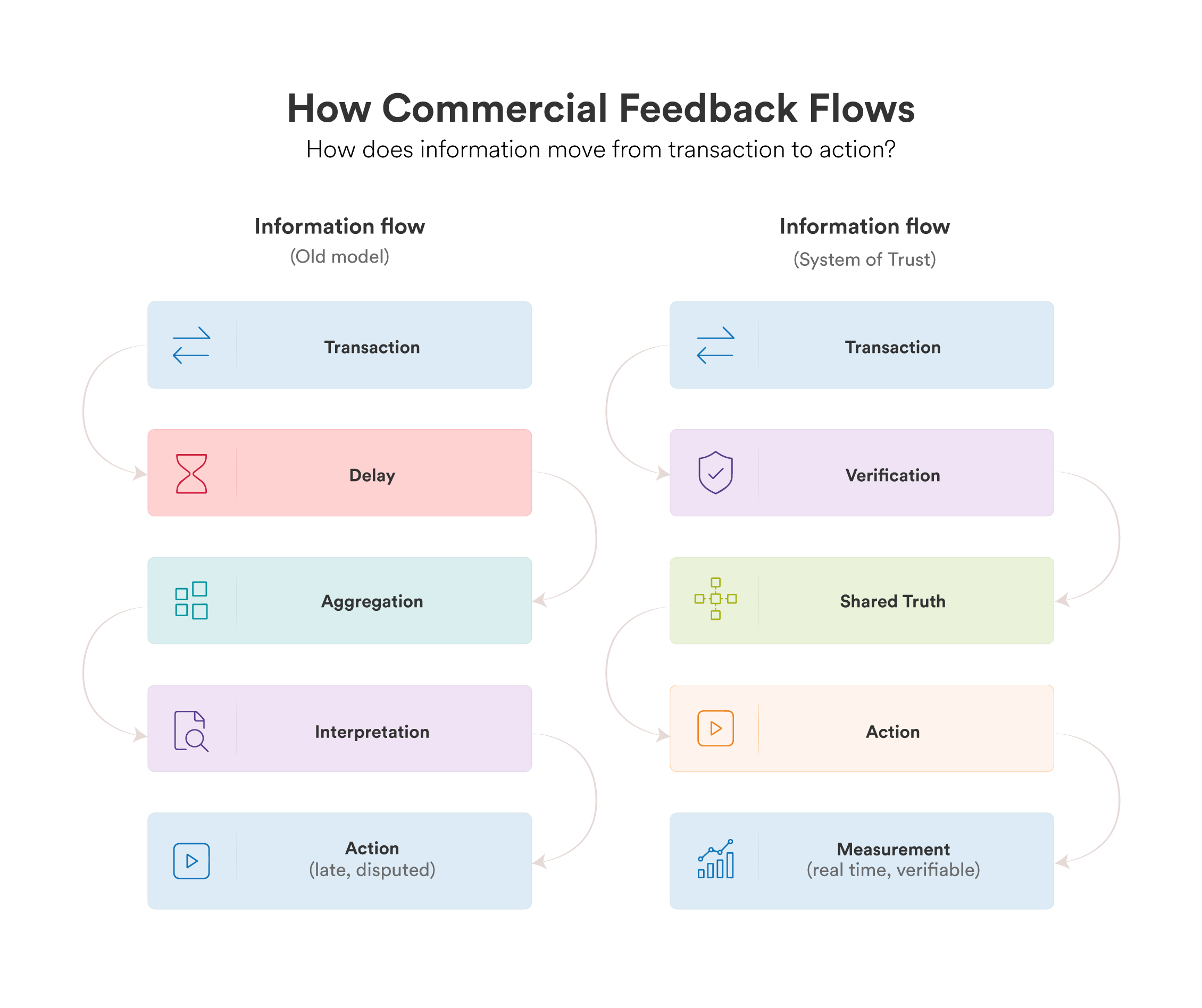
The data aggregation era: a necessary workaround
Historically, retailers and brands did not share feedback directly.
Retailers owned sales data. Brands needed insight. Technology and standards were insufficient to support trusted, real-time exchange. An intermediary market emerged.
Data aggregation companies purchased sales data from retailers, combined it across regions, and resold it to brands - often bundled with consulting designed to interpret delayed signals. Brands were asking a third party what happened in terms of sales, promotions and special events, rather than engaging directly with the retailer who has the data in full and in real time.
Aggregation existed for a reason: trust was required, but direct trust was impossible. It also introduced three structural limitations:
- Data aggregated above the shelf.
- Feedback delayed by weeks.
- Retailers losing control of data monetisation - that is, realising the full value of the data on hand.
The constraint was not data scarcity. It was delayed truth. This system was not designed for AI.
Why aggregation fails AI
AI can learn from summaries and aggregated signals. But it learns less than the real world contains - because summaries compress context, drop edge cases, and blur causality.
What actually improves performance, reliably, is outcome-linked feedback. It needs verified, timely, contextual signals to:
- measure actions
- evaluate results
- learn continuously
Aggregation delivers abstraction - and usually delay. That's fine for reporting. It's weak for execution.
At global scale, companies like Walmart have shown that direct, near real-time sales feedback shared with suppliers materially improves what happens on shelf. Intelligent Commerce generalises that outcome - without requiring retailer scale or centralised power.
The unlock is simple:
Brands buy data directly from retailers, not third parties.
Use case - store-level beverage execution
An AI model optimising a beverage range trained on aggregated data optimises for the average fridge. An AI model trained on verified store-level outcomes optimises for this fridge, today.
Frame III - The unlock: closing the loop at the POS
Direct data sharing at the point of transaction
Today, the constraints that created aggregation no longer exist. When brands purchase real-time, shelf-level sales data directly from retailers, a System of Trust forms inside commerce.
This does not require retailers to change how they operate. The feedback loop is distributed through point-of-sale systems - the systems already present at the moment of transaction.
By integrating at the POS layer:
- actions are measured quickly
- outcomes become visible
- learning accelerates
Once embedded, removal increases uncertainty and operational cost - making reversion economically irrational.
The table metaphor - who has access to truth

Imagine all participants - retailers, suppliers, wholesalers, POS providers, and shopper signals - sitting around the same commercial outcome.
In the old model, retailers sit with the transaction. Brands sit outside the table, asking intermediaries what happened. Aggregation exists as a proxy for missing trust.
That table does not truly exist today. tapestry exists to build it. A trusted, permissioned, real-time feedback loop that gives every participant access to the same verified signal.
When this table exists:
- forecasting becomes evidence-based
- replenishment becomes anticipatory
- promotions become measurable mid-flight
- disputes become solvable by evidence
- collaboration becomes the default
- Overall performance across the supplier base and retailer base advances to a new level.
Frame IV - What changes: collaboration becomes operational
When feedback loops close, distance disappears. Instead of debating reports, participants work from the same live, verified signal. Conversations shift from justification to collaboration.
What follows is predictable:
- Joint store-level planning.
- Faster promotion testing.
- Coordinated replenishment.
- Real-time response to demand.
- The creation of a new and very powerful paradigm for supplier and retailer.
Wholesalers gain clarity. Retailers optimise capital. Brands compete on execution. Shoppers benefit from availability and relevance.
Shared incentives and governance
Systems of trust do not scale through enforcement. They scale when incentives are structurally aligned. Intelligent Commerce is designed so that every participant benefits directly from keeping the feedback loop accurate, open, and continuously verified. No party is compelled to participate. Each chooses to participate because the system makes them better off.
Retailers
Retailers retain full ownership and control of their data. Participation is opt-in at the retailer level and configurable by:
- category
- partner
- use case
- time horizon
Retailers may choose to monetise their sales data directly with brands, transforming an underutilised asset into a high-margin revenue stream - while simultaneously improving execution, availability, and capital efficiency inside their own business.
Crucially, pricing is anchored to outcomes measured in the retailer's own P&L. Value is not negotiated abstractly; it is observed, verified, and reconciled in real time.
Retailers may also choose to participate individually or as part of a collective, without surrendering data ownership.
Wholesalers and buying groups (collectives)
With explicit retailer permission, a wholesaler or buying group may act as a collective coordinator on behalf of participating retailers.
In this model:
- retailers retain ownership of their individual data
- participation remains opt-in at the store level
- outcomes are still measured at the store and category level
- governance rules are enforced by the system, not by the wholesaler
The wholesaler gains the ability to:
- manage category programs across a trusted cohort
- coordinate supplier engagement using verified outcomes
- optimise network-level inventory and replenishment
- deploy capital and support where execution impact is highest
This allows wholesalers to move from reactive network management to coordinated optimisation, while preserving retailer autonomy and trust. The wholesaler does not own the data. They are authorised to operate the loop on behalf of the collective.
Brands
Brands pay for execution-quality signals - not delayed summaries or aggregated proxies. They gain access to real-time, shelf-level feedback that improves:
- trade-spend efficiency
- field execution
- range and space optimisation
- speed of learning
Because outcomes are measured against the same underlying sales data that governs participation and pricing, trust is maintained through evidence rather than negotiation. Brands may engage directly with individual retailers, or with authorised collectives where retailers have opted in.
Point-of-sale providers
POS providers sit at the moment of transaction - the source of truth - yet have historically captured little of the value created there. In Intelligent Commerce, this imbalance is corrected.
When data is monetised, the facilitator allocates a portion of transaction economics to the POS provider, recognising their role in:
- capturing the transaction
- standardising the schema
- enabling verification
- distributing the feedback loop at scale
This transforms POS platforms from passive systems of record into active participants in value creation, aligning them economically with trust, data quality, and adoption.
The facilitator
The role of the facilitator is not to extract value, but to govern, verify, and align the feedback loop.
The facilitator:
- enforces participation and pricing rules
- verifies outcomes against underlying sales data
- orchestrates data flows and AI workflows
- transparently allocates economics based on contribution
The facilitator retains a portion of each transaction to sustain governance and orchestration - and shares value with the POS layer where verification occurs. The facilitator does not own the data. It governs the system that makes trust measurable.
Why this scales
- Participation is voluntary.
- Pricing is outcome-based.
- Verification is continuous.
- Retailers may act alone or as collectives.
- Wholesalers coordinate with permission, not control.
- Brands pay for evidence, not opinion.
Because value is measured against the same underlying sales data for all parties, gaming is limited, renegotiation is reduced, and trust compounds naturally. As participation grows, operating outside the loop becomes economically inferior.
Power compounds through participation - not control.
The Intelligent Commerce flywheel
- Real-time data improves execution.
- Execution produces measurable outcomes.
- Outcomes align incentives.
- Aligned incentives increase participation.
- Participation improves data quality.
- Better data strengthens AI orchestration.
Alternative models are not competed away. They become economically irrational.
Frame V - Proof: trust becomes economics
The Store-Based Economic Impact Model (v2)
Trust is philosophy. Impact is proof.
To quantify the System of Trust, we maintain the Store-Based Economic Impact Model that estimates value per store, per year across three scenarios. The figures cited here are from v2 of the Retail+ Economic Impact Report (May 2026), in which retail costs were corrected and the supplier contribution lever was moved out of the headline range. The model is designed to be conservative and transparent.
We measure five impact channels:
- Sales uplift
- Cost reduction
- Margin expansion
- Customer satisfaction
- Compliance & friction reduction
Customer satisfaction is treated as a leading indicator (e.g., fewer stock-outs, better availability, fewer complaints) and is tracked separately unless a retailer has a defensible monetisation method.
Each metric is:
- store-level
- benchmark-informed
- scenario-tested (conservative / moderate / aggressive)
- assigned a confidence score (0–100) based on input quality and evidence strength
Role-based economic impact
Retailers (modelled at A$30m revenue per store, 27% gross margin)
Before: delayed, negotiated, indirect. After: real-time, evidence-driven execution.
v2 publishes two ranges per store, per year:
- Core range - lever 5 (supplier contribution margin) excluded; the external claim figure: ~A$27.5k Conservative · ~A$85.7k Moderate · ~A$181.4k Aggressive
- Full range - lever 5 included; the internal planning figure: ~A$32.5k Conservative · ~A$100.7k Moderate · ~A$221.4k Aggressive
The component drivers behind the Moderate scenario:
- Revenue uplift (sales recapture): +0.2% to +1.0% - moderate case +0.5%
- Margin improvement: +5 to +30 basis points - moderate case +15 bps
- Reference translation: 10 bps on A$30m sales = A$30,000 additional gross profit
- Hours returned (capacity unlocked): 4 to 12 hours/week - moderate case 8 hours/week
- Compliance & friction avoided (expected value): ~A$3k to ~A$25k/year per store
- Supplier contribution margin (optional, full-range only): ~A$5k to ~A$40k/year per store where supplier access is activated and governed
At scale, annual impact at the Moderate case:
- 25 stores · ~A$2.14m/year (≈ A$85.7k per store)
- 100 stores · ~A$8.6m/year
- 1,000 stores · ~A$85.7m/year
Payback against the Retail+ subscription: ~1.8 months Conservative, ~0.6 months Moderate, ~0.3 months Aggressive. Working-capital efficiency improves alongside.
"We see this technology as a significant step forward for independent retailers."
Brands & manufacturers
Before: delayed reporting, partial visibility, and hard-to-prove ROI. After: governed access to retailer-approved performance signals, faster learning cycles, and a cleaner line from action to outcome.
Brands and manufacturers benefit when retailer execution improves and decisions speed up. The economic impact typically comes through:
- Improved trade-spend efficiency - better evidence on what worked (and what didn't) reduces repeated spend on low-return mechanics and speeds up optimisation.
- Fewer "blind" promotions and resets - faster feedback helps refine depth, timing, placement, and ranging changes before waste compounds.
- Better joint business planning - shared, permissioned facts reduce debate and increase the number of decisions that can be made with confidence.
- Reduced reporting burden and rework - where retailer permissions allow, structured data access can replace ad-hoc report requests and manual reconciliation.
What changes in practice: brands move from retrospective "what happened?" reviews to a tighter loop: see → decide → execute → confirm.
"The ability to access real-time shelf-level intelligence is a step-change in how suppliers and retailers can work together to better serve the customer, which in turn drives growth for all involved."
POS providers
Before: systems of record with limited participation in the value created at transaction. After: the distribution layer for trusted feedback loops - rewarded for verification, data quality, and adoption.
POS providers sit at the moment of transaction: the highest-fidelity signal in commerce. In Intelligent Commerce, POS platforms become active participants in value creation - not because they "own" the data, but because they enable the loop to be captured, standardised, verified, and distributed.
Where the economics show up:
- New revenue streams tied to permissioned data access and workflow distribution (where the retailer opts in)
- Higher retention and lower churn because the POS becomes embedded in day-to-day execution workflows, not just compliance
- Upsell/attach uplift as analytics, collaboration, and automation become part of the core operating model
- Service cost reduction through fewer disputes, cleaner data, and faster resolution
"tapestry empowers retailers with valuable data insights, enabling smarter decisions and driving business growth."
Shoppers
- Reduced stock-outs
- Improved relevance
- Higher satisfaction
Commerce feels better when truth flows.
Case study - Store-level space optimisation unlocks category growth
One of the clearest examples of a workflow unlocked by closed feedback loops is the ability for suppliers to optimise physical shelf and fridge space at the individual store level - aligning range and layout to actual category consumption in that specific location.
Historically, this was impossible. Without store-level sales feedback, suppliers were forced to standardise formats across broad store types. Decisions were made using aggregated, delayed, or regional data - layouts that reflected averages rather than reality.
The old model: standardisation by necessity
Consider a branded beverage fridge supplied by Coca-Cola in a supermarket, service station, convenience store, or hotel. Traditionally, the fridge layout would be standardised across formats:
- 30% bottled water
- 30% core soft drinks
- 20% energy drinks
- 20% new product development
This mix was applied regardless of the store's neighbourhood, shopper profile, or actual purchasing behaviour - not because it was optimal, but because store-level insight did not exist. The constraint was not execution capability. It was visibility.
The new model: optimisation by reality
With real-time, store-level sales feedback shared directly between retailer and supplier, a new workflow becomes possible. A sales representative can now optimise the fridge for that specific store.
In an affluent suburban location where bottled water dominates consumption, the fridge can be reconfigured to:
- 70% bottled water
- Multiple SKUs across good / better / best price tiers
- Reduced allocation to slower-moving categories
This is not a brand-level decision. It is a store-level execution decision, informed by verified local demand.
Economic impact
This single workflow change delivers material, measurable outcomes:
- Higher revenue per square metre
- Better capital efficiency for the retailer
- Improved execution quality for the supplier
- A more relevant shopper experience
In practice, optimising physical space in this way can deliver up to ~5% incremental sales growth for the supplier - without new products, additional promotions, or increased trade spend.
This is the difference between reporting on what happened and changing what happens next.
Frame VI - The evolution: AI becomes orchestration
Intelligent Commerce closes the feedback loop between retailers and brands. It also closes the loop between AI and the real economy by pairing intelligence with verified economic truth.
In this model, AI is not the hero. The feedback loop is.
When decisions are grounded in verified, real-world economic data, AI shifts from prediction to orchestration. With truth as its foundation, AI becomes an orchestrator:
- reconciling signals across fragmented systems
- identifying exceptions and opportunities
- recommending actions with economic context
- and learning continuously from the outcomes of those actions
AI's role is not to replace human judgment, but to collapse complexity - interpreting economic signals, prioritising decisions, and coordinating action between people, systems, and workflows. This enables trustworthy automation across software and physical systems.
Without truth, AI is confident and wrong. With truth, AI is confident and useful.
A System of Trust in commerce is therefore not just a technical architecture. It is the prerequisite for AI to move from impressive insight to reliable, real-world impact - and for Intelligent Commerce to compound over time.
Conclusion - Trust as infrastructure
Retail spent decades optimising goods while tolerating broken truth. A System of Trust changes that.
- It introduces the missing feedback loop.
- It dissolves the trust tax.
- It realigns incentives.
- It makes collaboration inevitable.
Intelligent Commerce is not "AI in retail." It is trust operationalised, value measured, and intelligence orchestrated at scale.
This system is live. It is real. And it is already compounding.
If Intelligent Commerce is a better model for how we buy, sell, and share information, then there is still significant work to be done. One important question remains:
What needs to be true for this to grow in the world?
From our perspective, the answer is clear. The economic impact at the store level must be large enough - and consistent enough - to matter. Behaviour only continues to shift when outcomes are measurable, repeatable, and materially better than the alternatives.
The tailwind is clear. Artificial intelligence is being rapidly adopted, and its effectiveness depends entirely on the quality and timeliness of its feedback loops. For now, we have laid a strong foundation. We will continue to refine our method - updating this model, strengthening its governance, and increasing its confidence over time.
Because trust, once operational, compounds.
The System of Trust - what comes after action.
The original essay. The philosophical frame that this thesis applies to commerce.
Read Part I