
TL;DR
- AI systems are only as powerful as the trust we place in them.
- The next frontier isn't just speed - it's certainty.
- Trust is built through feedback loops implemented to close the confidence gap.
- A System of Trust requires new infrastructure.
- Because of the confidence gap, the System of Trust is inevitable.
Why action needs trust
In 2023, the phrase "System of Action" entered the technology lexicon - popularised by David Yuan as the next evolution of Geoffrey Moore's Systems of Engagement and the earlier Systems of Record that defined the SaaS era. Systems of Action don't just record or inform decisions - they execute them: real-time, dynamic, embedded.
But beneath every action lies a more human question:
Can I trust this?
The next inevitable shift is the System of Trust - where predictions are tied to proof, outcomes are verified, and confidence compounds into adoption and growth.
Why we hesitate to act on AI
Spend five minutes with ChatGPT and you've likely felt it - that flicker of hesitation, that gut check: wait, is this true?
AI now tells us what to stock, who to target, what to do next. And yet CEOs, operators, and individuals pause. Why? Because recommendations without transparency trigger doubt:
- What is this based on?
- Can I trust the data?
- Whose interest is this serving?
This hesitation isn't just emotional. It's mathematical.
The problem of the confidence gap
AI outputs are probabilities, not facts. A forecast, a match score, a fraud alert - all are distributions, not certainties.
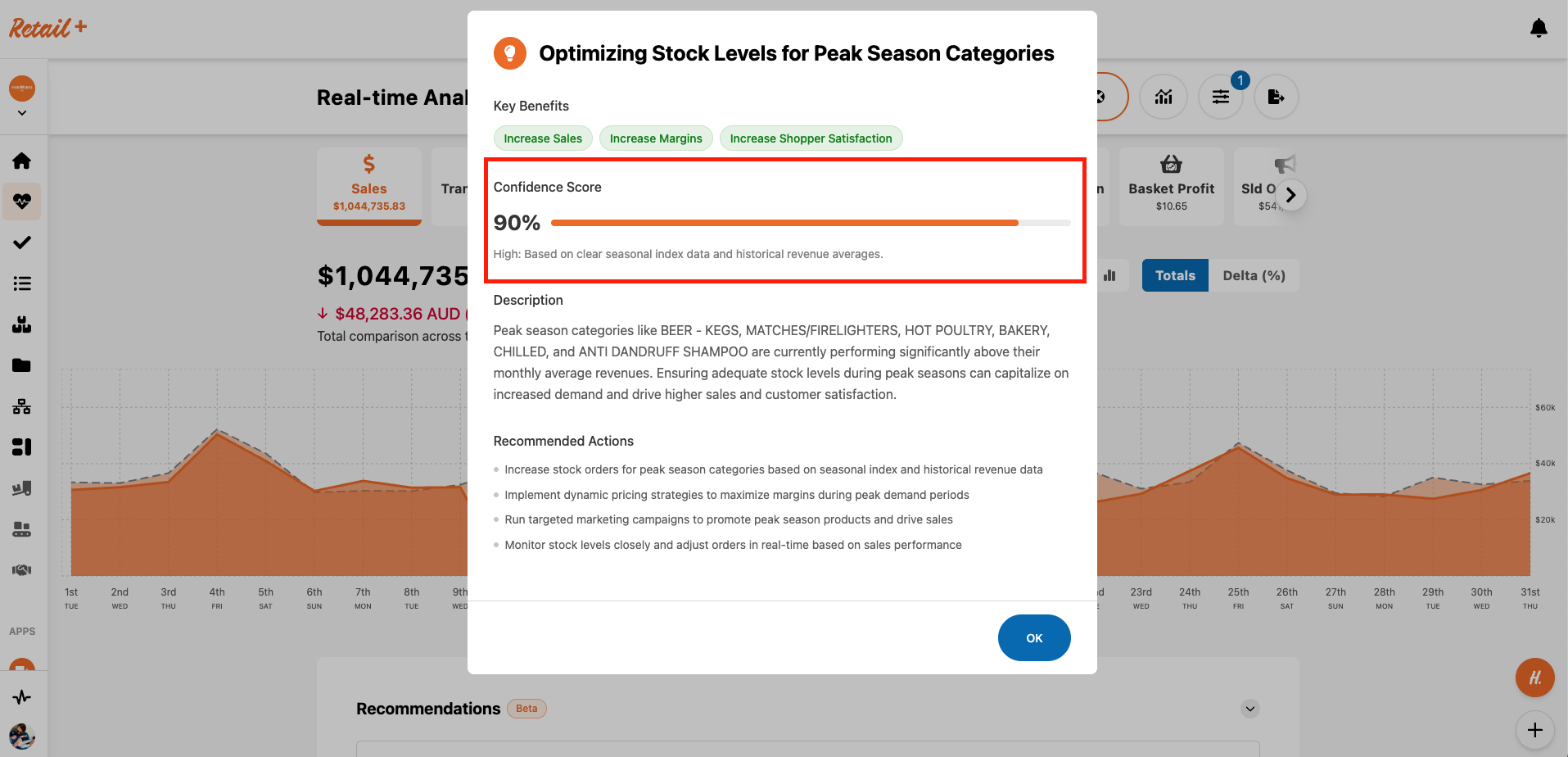
The problem:
- Predictions quantify uncertainty; they don't eliminate it.
- Without feedback, uncertainty compounds across decisions.
- The confidence gap widens until adoption stalls.
The solution: feedback loops that collapse uncertainty.
Every real-world outcome - sales, behaviour, loyalty - becomes a proof point. Each proof shrinks the gap, compounds confidence, and accelerates adoption.
AI without feedback is just a probability machine spinning into doubt. AI with feedback compounds into trust.
Feedback loops: quantitative and qualitative
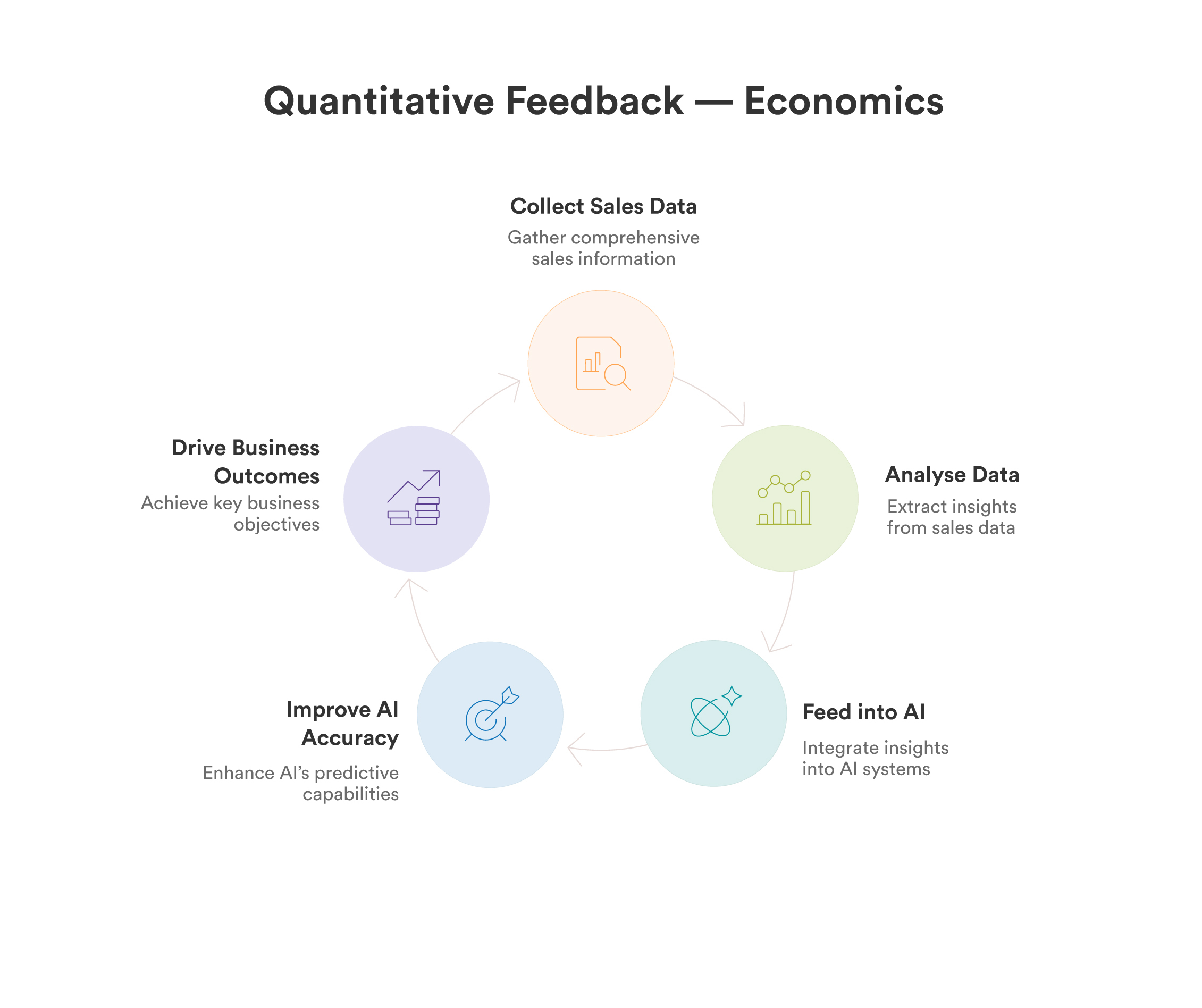
Quantitative feedback - economics
Sales data is the ultimate signal.
It is the most complete expression of commercial reality - where pricing, supply chain, customer behaviour, and competition intersect.
Feeding sales performance back into AI doesn't just sharpen accuracy. It aligns the system to what actually matters:
- Revenue growth
- Margin expansion
- Market share
- Customer satisfaction
- Shareholder value
Sales data doesn't just reflect the business - it steers it, by integrating directly into the AI feedback loop.
Qualitative feedback - values
Markets don't exist in a vacuum. Culture, politics, and sentiment shape them.
Platforms like Amplify in Australia are beginning to measure civic sentiment and loop it into decision-making.
- Economic feedback proves performance.
- Societal feedback proves alignment.
Personalisation and governance - the human layer
If sales data is the macro signal, personal data is the micro signal.
Each of us carries a map of affinities - the products, people, and experiences we value. Misread them, and trust collapses: loyalty drops, engagement withdraws, adoption stalls.
Personalisation is not convenience - it is confidence. But confidence compounds only under governance.
The equation is simple:
- No governance → withheld trust → adoption decays.
- Governance → each proof point compounds trust → adoption accelerates.
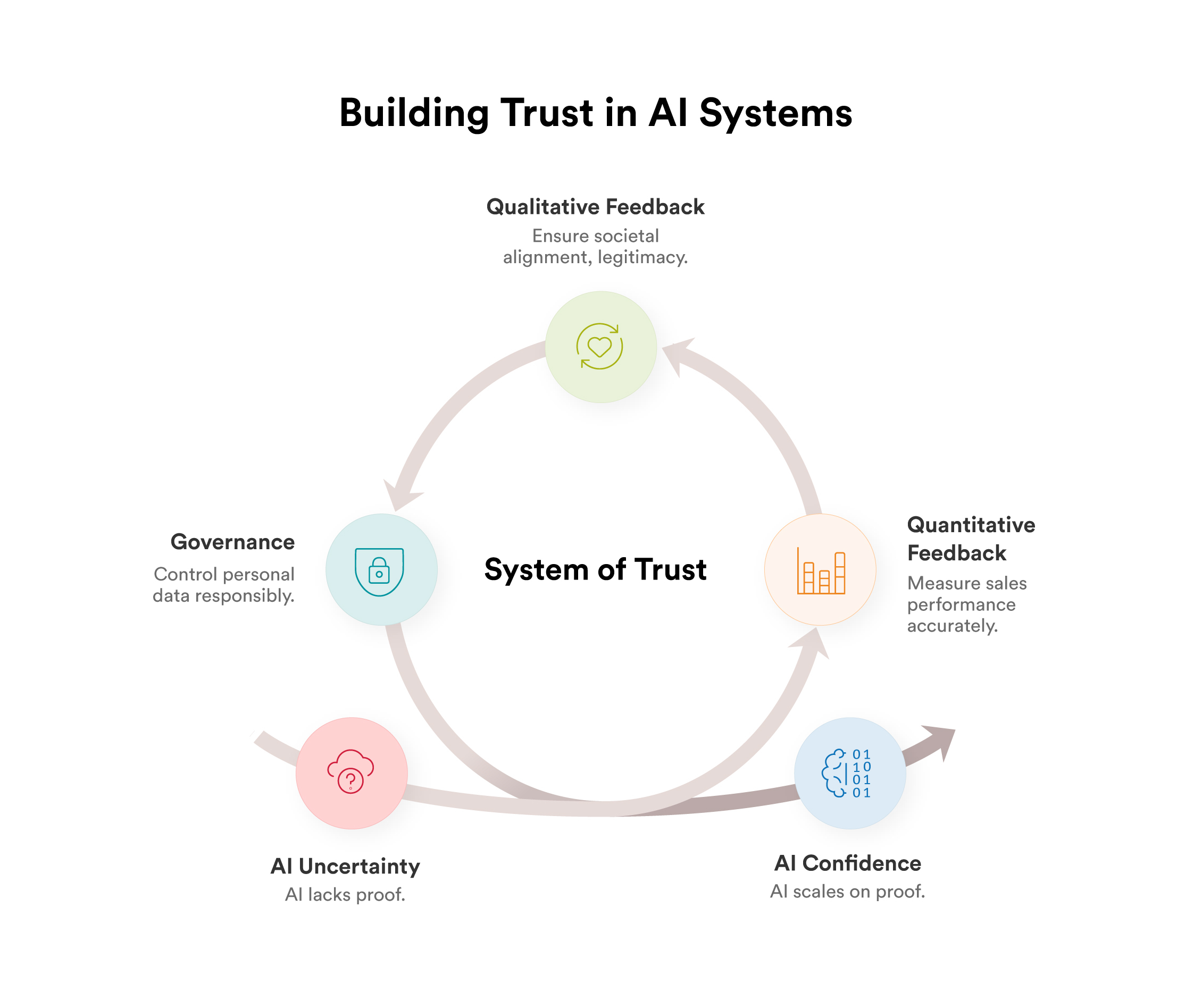
Thus the System of Trust requires both layers:
- Economic feedback to prove performance.
- Personal feedback to prove alignment.
Why closing the confidence gap matters
The confidence gap is not a minor hesitation. It is the invisible tax on every AI-powered decision.
- For businesses - it slows adoption, lengthens sales cycles, inflates CAC, and erodes ROI.
- For customers - it fractures loyalty and weakens NPS.
- For markets - it blocks compounding growth.
Without trust, AI stalls. With trust, AI compounds.
The mathematics of compounding trust
Trust compounds like interest.
Each proof point doesn't just add confidence - it multiplies it. Each loop tightens the bond between system and outcome, user and platform. Over time, this creates acceleration, not just adoption.
The equation is simple:
And trust is systematically mispriced. In markets, an increase in trust lowers CAC, shortens sales cycles, raises ALV, improves NPS, and drives virality.
This is the true network effect: compounding trust.
The infrastructure of the System of Trust
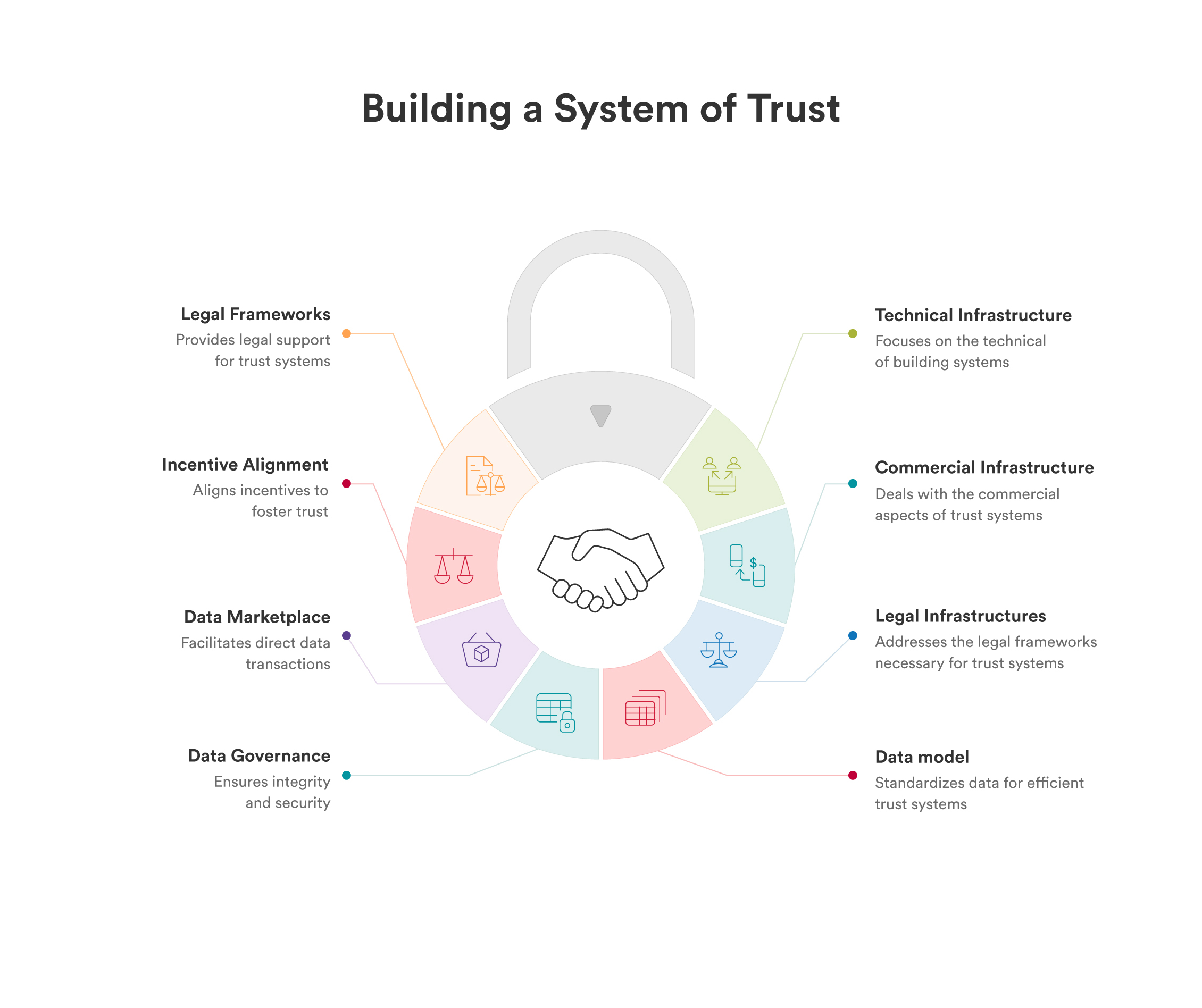
To build a System of Trust, new infrastructure must be developed and integrated:
- Technically
- Commercially
- Legally
A full System of Trust requires:
- A standardised data model
- Robust data governance
- A direct data marketplace
- Incentive alignment
- Legal frameworks for privacy, ownership, and exchange
For the first time, real-time data is already being bought and sold. Trust is no longer abstract - it is transactable.
Inevitability
The System of Record gave us memory.
The System of Action gave us speed.
The System of Trust gives us certainty.
Where there is doubt, there is hesitation. Where there is hesitation, growth is lost. That is the confidence gap. Which is where we are standing, and why -
The System of Trust isn't optional. It is inevitable.
For AI. For commerce. For society.
Intelligent Commerce - the System of Trust in action.
What changes when trusted feedback loops close at the point of transaction.
Read Part II